
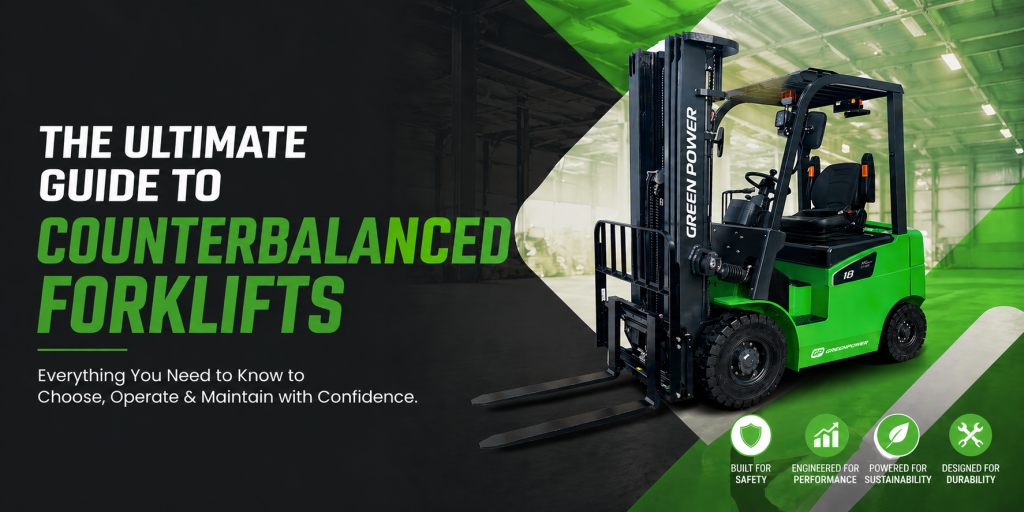
The counterbalance forklift is widely considered the most used and popular type of forklift in the world. It’s regarded as the standard forklift used in warehouses, factories and logistics centers is the most popular forklift. When people picture a forklift, they almost always picture a counterbalanced forklift. That says a lot about how dominant and essential this machine is.
From busy loading docks and distribution centres to manufacturing plants and construction yards, the counterbalance forklift is the backbone of material handling operations across virtually every industry.
But despite how familiar they look, there’s a huge amount to understand about counterbalance forklifts before you invest in one. Choosing the wrong type, power source, capacity or configuration can cost your business significantly in lost productivity, higher running costs and safety risks.
At Greenpower Forklifts, we specialise in lithium-powered counterbalance forklifts. We’ve helped businesses across the UK unlock serious cost savings and operational improvements by switching to the right equipment. Let’s start from the very beginning.
What Is a Counterbalance Forklift?
A counterbalance forklift is an industrial lift truck designed to pick up, carry and stack heavy loads using two metal forks at the front of the machine. The defining feature is the heavy counterweight built into the rear of the vehicle. This counterweight eliminates the need for additional stabilising legs or supports, allowing the forklift to approach loads directly.
Think of it like a seesaw. When you sit on one end of a seesaw, you go down and the other end goes up. A counterbalance forklift works on the same principle. The weight of the machine and its rear counterweight act against the weight of the load being carried at the front. This keeps the truck balanced and prevents it from tipping forward, even when carrying heavy pallets or industrial materials.
Counterbalanced forklifts carry their loads in front of their support point. The effort weight consists of the entire machine, including the chassis, motor, transmission, hydraulic pump and other control devices. The counterbalance, normally fixed to the back of the chassis, is also part of this effort weight.
The front axle acts as the fulcrum point, the pivot in the lever system. This engineering is simple but extraordinarily effective, which is why it remains the most widely used forklift design in the world.
Unlike reach trucks or articulated forklifts that use extending masts or outrigger legs to stay stable, a counterbalance truck needs none of these. Its sleek design, lacking protruding stabilisers, lets it easily navigate confined areas, ensuring optimal warehouse storage configurations and minimising unnecessary movements. This also makes it quick and easy to operate, reducing training time and improving productivity.
How Does a Counterbalance Forklift Work?
Understanding the mechanics of a counterbalance forklift will help you operate it more safely and choose the right spec for your needs.
The Hydraulic Lift System
The lifting process in a counterbalance forklift relies entirely on its hydraulic system. Using levers, the operator channels hydraulic fluid into the device’s cylinders, pushing pistons that elevate the mast and forks. When the operator pulls back on the lift lever, hydraulic pressure builds and raises the carriage along the mast. When they push the lever forward, hydraulic fluid is released and the forks lower. This system is precise, powerful and very reliable.
The Mast
The mast is the vertical structure at the front of the forklift. The forks are mounted to a carriage that slides up and down along the mast using the hydraulic system. Most standard masts also allow the operator to tilt the mast forward or backwards. Tilting the mast back during travel keeps the load secure. Tilting it forward helps when placing loads onto racking or trucks.
The Counterweight
The counterbalance principle uses rear weight to offset front loads, allowing operation without outriggers. The counterweight is usually a heavy iron or steel casting bolted to the rear of the chassis. Its size and weight are precisely calculated by engineers to balance the maximum rated load at the correct load centre distance. The load centre is the distance from the heel of the forks (where they connect to the carriage) to the centre of gravity of the load.
Steering and Drive
Most counterbalance forklifts use rear-wheel steering. This might seem unusual if you’re used to cars, but it makes sense on a forklift. Steering from the rear allows the front wheels, which carry the heavy load, to drive in a straight line, while the rear swings around corners.
This gives the machine a tight, responsive turning radius. The driving wheels are typically at the front and on three-wheel models, a single steered wheel sits at the rear. On four-wheel models, two driven front wheels and two rear steering wheels are used.
Types of Counterbalance Forklifts: Which One Is Right for You?
Counterbalance forklifts come in several configurations. The right one depends on your environment, load requirements and space constraints.
3-Wheel Electric Counterbalance Forklifts
Three-wheel models feature two front wheels and a single rear wheel. The single rear wheel gives these trucks an exceptionally tight turning circle, making them ideal for confined indoor spaces. They are almost exclusively electric and are popular in operations where space is premium. They’re slightly less stable than four-wheel models when carrying very heavy loads, so they’re typically rated up to around 2,000kg capacity.
If you work in a smaller warehouse, a food retail environment or anywhere with tight internal corridors, a 3-wheel electric counterbalance forklift is likely your best option. Greenpower specialises in lithium battery-powered counterbalance forklifts, offering both 3-wheel and 4-wheel models. All counterbalance forklift batteries are covered under a 5-year warranty.
4-Wheel Electric Counterbalance Forklifts
Four-wheel electric counterbalance forklifts are the most widely used type in warehousing, logistics and manufacturing. They offer greater stability, higher capacities and are suitable for both indoor and some outdoor use on hard, level surfaces. They are available in capacities ranging from around 1,500kg up to 5,000kg in standard configurations and larger industrial models go well beyond that.
Four-wheel electric models are the workhorses of most UK warehouses and distribution centres. They’re reliable, efficient and increasingly powered by lithium-ion batteries, which dramatically reduce charging time and maintenance requirements.
Diesel Counterbalance Forklifts
Diesel counterbalance forklifts use an internal combustion engine running on diesel fuel. They are powerful, capable of high capacities and designed for heavy outdoor use, construction sites, timber yards, ports and anywhere that requires working on rough ground or in open environments where emissions aren’t a concern. Diesel forklifts typically require wider aisles and produce exhaust emissions that make them unsuitable for enclosed indoor use.
Counterbalance Forklift Capacities Explained
One of the most important specifications to understand when selecting a counterbalance forklift is its rated capacity. This is the maximum weight the forklift can safely lift under defined conditions.
A forklift’s capacity tells you the maximum weight it can safely lift. With counterbalance models, always check the rating plate, a small metal plate on the forklift, for the rated load limit. You do not want to exceed this number.
It’s also critical to understand the concept of the load centre. Your forklift can lift less weight as the load moves further away from the mast. This distance is called the load centre. For instance, if your forklift can safely lift 2,000kg at a 500mm load centre, heavier or oddly shaped items will reduce that limit. Also, attachments like clamps or fork extensions can change your forklift’s capacity.
Here’s a general breakdown of counterbalance capacity ranges and typical applications:
| Capacity Range | Typical Applications |
| Up to 1,500kg | Light warehousing, retail, small manufacturing |
| 1,500kg – 2,500kg | Standard warehouse pallets, distribution centres |
| 2,500kg – 4,000kg | Manufacturing, heavier pallets, building supplies |
| 4,000kg – 8,000kg | Industrial manufacturing, heavy logistics |
| 8,000kg+ | Steel, ports, large construction and industrial |
High-capacity models (4,000kg and above) are suited for heavy manufacturing or construction environments where bulky materials like steel piping must be lifted regularly. Keeping your load requirements in mind helps you avoid investing in an underpowered or excessively large machine.
Always match your forklift’s capacity to your heaviest regular load, not just your average load. Building in a safety margin is good practice.
Electric vs Diesel vs LPG Counterbalance Forklifts: A Full Comparison
Choosing a power source is one of the biggest decisions you’ll make. Each option has different upfront costs, running costs, maintenance demands and environmental impacts. Here’s everything you need to know.
Purchase Price
The initial cost of a lithium-powered forklift varies depending on the model and your business needs. Electric Counterbalance Forklifts from Greenpower range from roughly £10,000 to £25,000. The higher-priced ones offer extended lift heights and load capacity.
A 2.5-tonne diesel counterbalance might cost £18,000-£30,000, while an equivalent lithium-ion electric model might cost £28,000-£35,000. The purchase price tells only a fraction of the story, what a machine costs to run over its lifetime is far more important.
Fuel and Energy Costs
UK business electricity currently costs about 22.36p/kWh. An electric forklift drawing roughly 5kWh per hour costs about £1.10 per hour in electricity. Diesel fuel averages 142p per litre and a diesel forklift burns 2-3 litres per hour, leading to an hourly fuel bill of £2.80-£4.30. Electric forklifts are therefore typically £1.50-£3.00 per hour cheaper to run than equivalent diesel models. Over an eight-year service life, this difference can easily offset the higher purchase price of an electric lift and, in many cases, delivers payback within two years.
From a pure “per hour” fuel perspective, electric is now roughly 70% cheaper to run than diesel in the UK.
Maintenance Costs
A diesel forklift fitted with DPF and AdBlue systems requires significant ongoing maintenance. Expect to pay £2,000-£4,000 per year in servicing, oil changes and DPF maintenance. Electric maintenance costs are expected to be £500-£1,200 per year, with no oil changes and regenerative braking meaning brake pads last significantly longer.
Electric forklifts have approximately 30-40% lower maintenance costs compared to diesel equivalents, due to fewer moving parts, no engine oil changes and simpler mechanical systems.
Lifespan and Total Cost of Ownership
Diesel forklifts commonly last 10,000-15,000 hours. Future emission regulations may reduce their lifespan. Electric forklifts typically last 15,000 to 20,000 hours. Opting for an electric forklift over a diesel model is a smart investment that delivers long-term cost savings. While the electric forklift price may be higher upfront, the reduced fuel costs and lower maintenance expenses make them the better choice over time. See here for a full breakdown on the cost of ownership.
Emissions and Indoor Use
Diesel forklifts produce significant exhaust fumes. They should not be used in enclosed spaces without strong ventilation. Even then, they create health risks for operators and nearby workers. A diesel forklift emits roughly 12,000kg of CO2 per year based on average usage. An electric forklift, when charged using the UK’s increasingly green grid or on-site solar, can reduce that to near zero.
Electric counterbalance forklifts produce zero emissions at the point of use, making them the only truly practical option for indoor warehouse environments.
Summary Comparison Table
| Feature | Electric (Lithium) | Diesel | LPG |
| Purchase Price | £10,000-£35,000+ | £18,000-£30,000+ | £15,000-£25,000+ |
| Hourly Running Cost | ~£1.10 | ~£2.80-£4.30 | ~£2.00-£3.50 |
| Annual Maintenance | £500-£1,200 | £2,000-£4,000 | £1,500-£3,000 |
| Indoor Use | Yes (ideal) | No (emissions) | Limited (ventilation needed) |
| Outdoor Use | Yes (hard surfaces) | Yes (excellent) | Yes |
| Emissions | Zero | High | Moderate |
| Lifespan | 15,000-20,000 hrs | 10,000-15,000 hrs | 10,000-15,000 hrs |
| Noise | Very low | High | Moderate |
| Payback Period | 2-3 years | N/A | N/A |
Lithium-Ion vs Lead-Acid Batteries
If you’ve decided on an electric counterbalance forklift, your next choice is battery type. The two main options are lead-acid and lithium-ion, and the differences are substantial.
Lead-Acid Batteries have been used in electric forklifts for decades. They are cheaper upfront and widely available. However, they require regular maintenance, operators must check and top up electrolyte fluid levels. Lead-acid batteries also take a long time to charge, typically 8 hours or more and should not be discharged below 20% to avoid damage. They lose voltage as they drain, meaning a forklift running on a partly depleted lead-acid battery actually has less lifting power and speed than one on a full charge.
Lithium-Ion Batteries are the modern standard and for good reason. They charge significantly faster, often in under two hours, and can be opportunity charged during breaks without damaging the battery. Unlike lead-acid, which loses voltage as the battery drains, lithium-ion provides 100% performance until the battery hits 0%. Lithium batteries also require zero maintenance. Lithium-ion batteries generally last longer, with 3,000-5,000 cycles possible, potentially extending lifespan to 8-10 years.
At Greenpower Forklifts, we are the UK’s number one leaders in lithium technology. Our entire counterbalance range is lithium-powered, and all battery packs come with a 5-year warranty. For businesses running single or multi-shift operations, lithium-ion is simply the smarter long-term investment.
Counterbalance Forklifts vs Other Forklift Types
Understanding how a counterbalanced forklift compares to other truck types will help you decide whether it’s the right choice or whether a different machine might suit your operation better.
Counterbalance vs Reach Trucks
Reach trucks are designed for narrow aisle warehousing and high racking. They have a set of outrigger legs at the front and an extending mast that can push the forks forward into racking without the entire truck entering the aisle. Reach trucks have an extendable fork that can reach into racking systems. They have a higher lift capacity in confined spaces and are ideal for environments with limited space, but are less versatile for outdoor use compared to counterbalance models.
Counterbalance forklifts are better for loading and unloading vehicles, general outdoor yard work, heavy-duty lifts and operations that don’t require the truck to work deep inside very narrow racking aisles. Reach trucks are better for high-bay, dense warehouse storage. Many operations benefit from having both.
Counterbalance vs Articulated Forklifts
Articulated forklifts combine features of counterbalance trucks and narrow-aisle trucks. They can operate in aisles as narrow as 1.6-2 metres, making them extremely space-efficient. An articulated forklift can often replace a counterbalance forklift, a reach truck and a VNA truck combined, making fleet management simpler and reducing capital expenditure.
However, counterbalance forklifts are generally better for loading docks, container work, outdoor use and any scenario where the machine needs to travel longer distances with heavy loads. Articulated forklifts are better suited to high-density indoor warehousing where aisle space is critical.
Counterbalance vs Pallet Trucks
Pallet trucks, both manual and electric, are used for moving palletised loads horizontally across flat surfaces at floor level. They have a lower lift capacity and are not suitable for lifting heavy loads to height. However, they are perfect for indoor applications and tasks that require minimal lifting.
Counterbalance forklifts do everything a pallet truck does, plus they can lift loads to height, stack racking, load vehicles and handle outdoor terrain. If you need to do more than move pallets around the floor, a counterbalance forklift is the answer.
Full Comparison Table
| Feature | Counterbalance | Reach Truck | Articulated | Pallet Truck |
| Aisle Width Required | 3.0–4.0m | 2.7-3.2m | 1.6-2.0m | Any |
| Lift Height | Up to 7.5m standard | Up to 12m+ | Up to 12m+ | Floor level |
| Indoor Use | Yes | Yes (ideal) | Yes (ideal) | Yes |
| Outdoor Use | Yes (electric/diesel) | No | Limited | No |
| Load Capacity Range | Up to 16,000kg+ | Up to 2,500kg | Up to 2,500kg | Up to 2,000kg |
| Versatility | Very high | Moderate | High | Low |
| Relative Cost | Moderate | Moderate | Higher | Low |
Key Features to Look For in a Counterbalance Forklift
Not all counterbalance forklifts are equal. Here are the features that make the most difference in real-world operations.
Mast Type
The mast is one of the most important specifications. Masts come in several configurations:
- Simplex (single-stage): Basic two-section mast. Lower lift height, fewer components. Good for loading vehicles and basic stacking.
- Duplex (two-stage): Allows the mast to remain at a lower overall height while still achieving good lift height. Useful where overhead clearance is limited.
- Triplex (three-stage): The most common in warehousing. Extends to greater heights while keeping the collapsed height low. Ideal for racking environments.
- Quadruplex (four-stage): For very high-bay applications requiring maximum reach.
Look for a mast that provides good visibility for the operator. The ability to see the forks and load clearly at all times is critical for safe and efficient operation.
Tyres
- Cushion tyres: Made from solid rubber pressed onto a metal band. Designed for smooth indoor floors. Lower ground clearance, not suitable for outdoor use.
- Pneumatic tyres: Air-filled or solid, similar to those on a car or van. Provide better grip and cushioning on rougher or outdoor surfaces.
- Polyurethane tyres: Often used on smaller electric models. Very durable and low rolling resistance.
Ergonomics and Operator Comfort
Operator comfort directly impacts productivity and safety. Look for adjustable seats, ergonomic controls, low vibration levels and good all-round visibility. Fatigue in forklift operators is a major contributing factor to accidents. Electric forklifts are inherently quieter and smoother to operate than diesel, which helps maintain operator alertness over long shifts.
Load Backrest
A load backrest extends from the top of the carriage behind the forks and prevents loads from sliding back towards the operator during travel and lifting. This is a critical safety feature on any counterbalance forklift and should be standard on every machine.
Sideshift
A sideshifter attachment allows the operator to move the forks left or right without repositioning the entire truck. This is enormously useful for accurate pallet placement and significantly reduces the time spent manoeuvring. Approximately 80% of all class I, IV and V forklifts on the market today have sideshifters installed. They are relatively inexpensive and easy to use and they offer immediate and measurable savings through increased productivity and reduced product and pallet damage.
Overhead Guard
Every counterbalance forklift must have a robust overhead guard – the protective cage above the operator’s head. This protects operators from falling objects. Never operate a forklift without a properly fitted and undamaged overhead guard.
Counterbalance Forklift Attachments: Expanding What Your Forklift Can Do
One of the great advantages of a counterbalance forklift is its ability to accept a wide range of attachments that transform it into a specialist tool for different applications. This versatility is one of the biggest reasons why counterbalance forklifts dominate material handling operations globally.
Here are the most important and widely used counterbalance forklift attachments:
Sideshifters: As mentioned above, sideshifters allow the forks to move laterally across the carriage. They reduce the need to reposition the truck during loading and unloading, saving time and reducing product and racking damage.
Fork Positioners: Similar to sideshifters but with the added ability to move each fork independently. Fork positioners allow the operator to move each fork individually, allowing the operator to quickly match the forks to different pallet sizes without getting off the truck. This is invaluable in operations handling a variety of pallet configurations.
Fork Extensions: Fork extensions slide over the existing forks to increase their effective length. Extensions increase the length of the forks, helping the equipment carry long or oddly-shaped loads. They’re useful for moving long timber, pipes, flooring or any load wider than standard pallets. Always ensure the centre of gravity of the load stays within the extended fork length.
Rotators: Rotators offer superior load and dumping versatility with 360-degree revolving motion in both directions. They allow the rotation of a load or bin automatically using the forklift’s hydraulic levers right from the operator’s seat. They’re widely used in agriculture, food and beverage, recycling, automotive and waste management.
Clamps Clamp attachments replace the standard forks and allow the forklift to grip loads from the sides. There are many types:
- Carton clamps: Ideal for moving large rectangular or square objects that aren’t on a pallet. Widely used in electronics, beverage and appliance industries.
- Bale clamps: For soft baled materials like cotton, hay and recycled paper or plastic. Common in agriculture and recycling.
- Paper roll clamps: Designed for the paper and printing industry. Paper roll clamps allocate the right pressure using automatic pressure controls to avoid crushing or damaging products.
- Drum and barrel clamps: For safely handling and, in some versions, tipping or rotating industrial drums and barrels.
Push-Pull Attachments: A push-pull attachment uses a faceplate and gripper to pull loads onto a slip sheet. After the forklift transports the load, the attachment then pushes the load off the sheet. These are used for items like bags of seed, corrugated boxes and packaged dairy. They reduce the need for pallets, saving cost and storage space.
Jibs and Crane Hooks: Jib attachments mount to the forklift carriage and extend a boom forward, turning the forklift into a mini crane. This allows lifting of loads that can’t be placed on forks, such as machinery, engines or construction equipment using slings.
Important Note on Attachments and Capacity
Every attachment you add to a counterbalance forklift affects its rated capacity. The additional weight and changed load centre of the attachment reduces the maximum load the forklift can safely carry. Always consult the attachment manufacturer’s data and your forklift’s rating plate before lifting loads with an attachment fitted. Operators should also be specifically trained on any attachment they use.
What Industries Use Counterbalance Forklifts?
The short answer is almost every industry that moves goods. But let’s look at where counterbalance forklifts are most commonly and effectively deployed.
Warehousing and Logistics – This is the most common application. Loading and unloading delivery vehicles, moving pallets between racking locations and supporting picking operations. Standard electric 4-wheel counterbalance forklifts dominate here, with capacities typically in the 1,500kg-3,000kg range.
Manufacturing – Counterbalance forklifts keep production lines fed with raw materials and remove finished goods efficiently. They handle everything from components delivered on pallets to large machinery parts. Capacities across the full range are used depending on the materials involved.
Food and Beverage – The food and beverage industry is one of the highest-volume users of counterbalance forklifts. Electric models are preferred for indoor use due to zero emissions and compliance with food safety standards. Specialised attachments like carton clamps, paper roll clamps and multiple pallet handlers are widely used.
Construction – Diesel counterbalance forklifts are a staple on construction sites. They handle bricks, blocks, timber, steel, concrete products and roofing materials. Higher ground clearance, pneumatic tyres and powerful diesel engines make them ideal for rough outdoor terrain.
Retail and Distribution – Supermarkets, DIY stores and retail distribution centres rely on counterbalance forklifts to process deliveries and replenish stock. Compact 3-wheel electric models are popular in this sector for their manoeuvrability in tight spaces.
Automotive – Car components, chassis parts and heavy mechanical assemblies all require careful, powerful material handling. Counterbalance forklifts with higher capacities and specialist attachments like frame clamps and spreader bars are standard across the automotive supply chain.
Cold Storage – Electric counterbalance forklifts are the preferred choice for cold stores and refrigerated environments. They produce no exhaust fumes, which is important in enclosed spaces. Lithium-ion batteries also maintain their performance better in cold temperatures than lead-acid alternatives.
Agriculture – Farms, agricultural merchants and grain stores use counterbalance forklifts extensively for moving feed sacks, fertiliser pallets, produce crates and baled products. Both diesel and LPG models are widely used outdoors, while electric models are increasingly adopted for indoor agricultural buildings.
Counterbalance Forklift Safety: Everything You Need to Know
Forklifts are powerful machines that can cause serious injury or death when misused. Understanding counterbalance forklift safety is not optional, it’s a legal and moral obligation for every employer and operator in the UK.
A 2023 safety report showed that nearly 35% of forklift accidents happened because of improper loading or turning. The good news is that the majority of forklift accidents are preventable through proper training, well-maintained equipment and sensible operational practices.
Pre-Use Checks
Before operating any counterbalance forklift, operators should complete a thorough pre-use inspection. This includes:
- Checking the forks for cracks, bends or wear
- Inspecting the mast and hydraulic hoses for leaks or damage
- Checking tyre condition and pressure (where applicable)
- Verifying the overhead guard is intact and secure
- Confirming the load backrest is in place
- Checking all warning lights and alarms are functional
- Verifying the battery charge level (electric models)
- Checking fuel levels (diesel or LPG models)
- Confirming the seatbelt is functioning correctly
Any defects found during pre-use checks must be reported immediately. The forklift should not be operated until defects are rectified.
Stability and Tipping
One of the most serious risks with any counterbalance forklift is tipping. The stability of a counterbalance forklift is governed by what’s called the stability triangle, an imaginary triangle formed by the two front wheels and the rear axle pivot point. As long as the combined centre of gravity of the truck and load stays within this triangle, the truck is stable.
Tipping can occur when:
- The load is too heavy for the truck’s capacity
- The load is lifted too high during travel
- The truck turns too sharply at speed with a raised load
- The load is unevenly distributed on the forks
- The truck operates on an incline
Understanding and respecting the stability triangle is fundamental to safe forklift operation.
Pedestrian Safety
Separating forklift traffic from pedestrians is one of the most important safety measures in any warehouse or yard. Clearly marked pedestrian walkways, barriers, speed limits, horn-use protocols and vehicle priority zones all help prevent collisions. Blue spot lights are widely used to project a visible beam of light ahead of an approaching forklift, alerting pedestrians to an incoming truck even before they can hear or see it.
UK Legal Requirements for Counterbalance Forklifts
Counterbalance forklifts are subject to a comprehensive framework of UK health and safety legislation. Understanding these laws is essential for every employer and operator.
Health and Safety at Work Act 1974
The Health and Safety at Work Act places the onus on employers to ensure that employees are safe while they are at work. Forklifts are powerful machines that create significant risks when misused or poorly maintained. Employers have a legal duty to ensure safe equipment, safe practices and adequate training.
PUWER 1998 (Provision and Use of Work Equipment Regulations)
PUWER requires you to ensure forklifts meet safety standards and are fit-for-purpose, kept in good repair via a maintenance log, and that operators are effectively managed for safe control of forklifts. Any forklift that is defective, incorrectly maintained or used by untrained operators puts an employer in breach of PUWER.
LOLER 1998 (Lifting Operations and Lifting Equipment Regulations)
LOLER specifically covers lifting equipment like cranes, forklifts and work platforms. Under LOLER, you must ensure forklifts and any accessories are inspected every year with a thorough examination. This is the equivalent of an MOT and is separate from your regular maintenance schedule. A thorough examination will certify that all the mechanical parts of your truck are working and safe.
This annual thorough examination is a legal requirement, not an optional extra. Forklifts that lift people (e.g. using a man cage) must be examined every six months.
How to Choose the Right Counterbalance Forklift for Your Business
Choosing the right counterbalance forklift isn’t complicated, but it does require you to think clearly about your specific operational needs. Work through the following questions before making a decision.
1. What is your maximum load weight? Identify the heaviest load you regularly need to lift. Factor in a safety margin and choose a forklift rated comfortably above this figure.
2. What is your load centre? Standard UK pallets typically have a load centre of 600mm. If you handle unusually large or long loads, your effective load centre may be further out, which reduces the safe capacity of the truck. Check this carefully.
3. What lift height do you need? Measure the height of your highest racking level and add a clearance margin. Make sure the mast you select reaches this height comfortably.
4. Where will the forklift be used? Indoor only – electric counterbalance is the clear choice. Outdoors on rough terrain – diesel or specialist outdoor electric. Both indoor and outdoor – four-wheel electric with pneumatic tyres, or diesel if heavy-duty outdoor work dominates.
5. What aisle widths do you have? Standard counterbalance forklifts typically need 3.0-4.0 metres of clear aisle width to operate. If your aisles are narrower than this, you may need to consider an articulated or reach truck instead.
6. How many shifts will you run? Single shift – any battery type works well. Multiple shifts – lithium-ion battery is the only practical choice without requiring battery changes or extended downtime.
7. What is your budget and total cost of ownership expectation? Don’t just look at the purchase price. Factor in energy costs, maintenance, expected lifespan and any downtime costs. Electric lithium-ion almost always wins on total cost of ownership over a 5-8 year period.
8. Do you have sustainability goals? If your business has carbon reduction targets, electric counterbalance forklifts are the only route to zero operational emissions. This is increasingly important for supplier contract compliance and ESG reporting.
Buying vs Leasing a Counterbalance Forklift
Once you’ve decided which counterbalance forklift you need, you’ll face another important choice: should you buy or lease?
Buying Outright – Buying gives you full ownership of the asset. It’s often the most cost-effective approach over the long term, especially for electric forklifts that have low running costs. You own the machine outright, can sell it later and have no ongoing lease payments.
Finance and Lease Options – At Greenpower Forklifts, we offer flexible finance packages to spread the cost of new counterbalance forklifts across manageable monthly payments. This preserves cash flow while still giving your business access to the latest lithium-powered equipment. Finance options can include hire purchase, finance lease and operating lease arrangements.
Why Choose Greenpower Forklifts for Your Counterbalance Forklift?
At Greenpower Forklifts, we’ve built our reputation on being the UK’s number one leaders in lithium counterbalance technology. We supply new electric counterbalance forklifts, both 3-wheel and 4-wheel, at some of the most competitive prices in the UK, with new models starting from as little as £8,250.
Every Greenpower counterbalance forklift features:
- Advanced lithium-ion battery technology
- 5-year battery warranty as standard
- Fast-charging capability – ready in hours, not overnight
- Zero emissions operation
- Minimal maintenance requirements
- Flexible finance packages available
- Fast 72-hour UK mainland delivery
We cover the whole of the UK, with teams based across the North, Midlands and South. Whether you need a single machine for a small business or are looking to electrify an entire fleet, we have the expertise, the stock and the support to make it happen.
Visit our counterbalance forklift page to explore our full range and current pricing, or contact us today to speak to a specialist.
Share:
FAQ's
-
What is the difference between a 3-wheel and 4-wheel counterbalance forklift?
A 3-wheel model has a single rear wheel, giving it a tighter turning circle and making it ideal for confined spaces. A 4-wheel model has greater stability and higher capacity but requires a wider turning radius. Four-wheel models are better for heavier loads and mixed indoor/outdoor use.
-
Can a counterbalance forklift be used outside?
Yes. Many counterbalance models are designed for outdoor environments such as construction sites and logistics yards. Electric models can be used outdoors on hard, level surfaces. Diesel and LPG models handle rougher outdoor terrain more effectively.
-
What weight can a counterbalance forklift lift?
Typical lifting capacity for a counterbalance forklift ranges from 1,000kg to over 10,000kg depending on the machine size. Specialist large-capacity models can lift significantly more.
-
Do I need a licence to operate a counterbalance forklift?
There is no formal "driving licence" for forklifts in the UK. However, operators must have had formal training in some form or another and this training must be structured, assessed and documented in compliance with PUWER and HSE guidance.
-
How often does a counterbalance forklift need servicing?
Electric counterbalance forklifts need servicing typically every 1,000 hours. Diesel and LPG models may need servicing every 250–500 hours. All forklifts require an annual LOLER thorough examination.
-
How long do electric counterbalance forklifts last?
Electric forklifts typically last 15,000 to 20,000 hours. With proper maintenance and lithium-ion battery care, this can exceed 10 years of productive working life.