
The wrong pallet truck costs more than you think. Operators slow down. Loads get dropped. Injuries happen. And that entry-level truck you bought to save money? It needs replacing within a year.
The right electric pallet truck helps your warehouse move faster, improve productivity and keep operations running smoothly. This guide walks you through exactly what to look for, so you can buy once and buy right.
What Is an Electric Pallet Truck?
An electric pallet truck is a low-lift, wheeled device that uses electric motor-driven power to raise and transport pallets. One operator. Up to 10,000kg. Minimal physical effort.
If your operation handles palletised goods in a warehouse, distribution hub, retail stockroom or delivery vehicle, you need one. Electric pallet trucks fill the gap between manual lifting and a full counterbalance forklift.
Not sure whether you need a pallet truck or a forklift? Read our guide: 7 Different Types of Forklifts and Their Purposes.
Manual vs Electric Pallet Trucks: Which One Is Right for My Operation?
Making the choice between manual and electric pallet trucks is one of the most important decisions you’ll make.
Manual pallet trucks are hand-powered and simple. They suit:
- Short distances (under 30 metres)
- Light to medium loads (up to 2,500kg)
- Sites with low pallet volume and no charging capabilities
Electric pallet trucks use motor-driven lifting and travel. They suit:
- Frequent, repetitive movements across longer distances
- Heavier loads and high-throughput environments
- Operations where operator fatigue is a concern
- Multi-shift warehouses needing consistent performance
Manual pallet handling is hard physical work, and productivity can drop as operators become tired. Electric pallet trucks provide consistent powered movement, helping operators maintain a steady pace throughout the working day, whether they’re moving the first pallet or the tenth.
If your team is moving pallets regularly throughout the day, switching to an electric pallet truck can help improve productivity, reduce physical effort and make everyday material handling more efficient
What Electric Pallet Truck Capacity Do I Need?
Load capacity is the single most critical specification when choosing a pallet truck. Getting it wrong is dangerous.
Here’s how Greenpower’s range breaks down by capacity:
| Capacity | Application | Greenpower Model |
| 1,500kg | Light-duty, retail, last-mile delivery | DC15 |
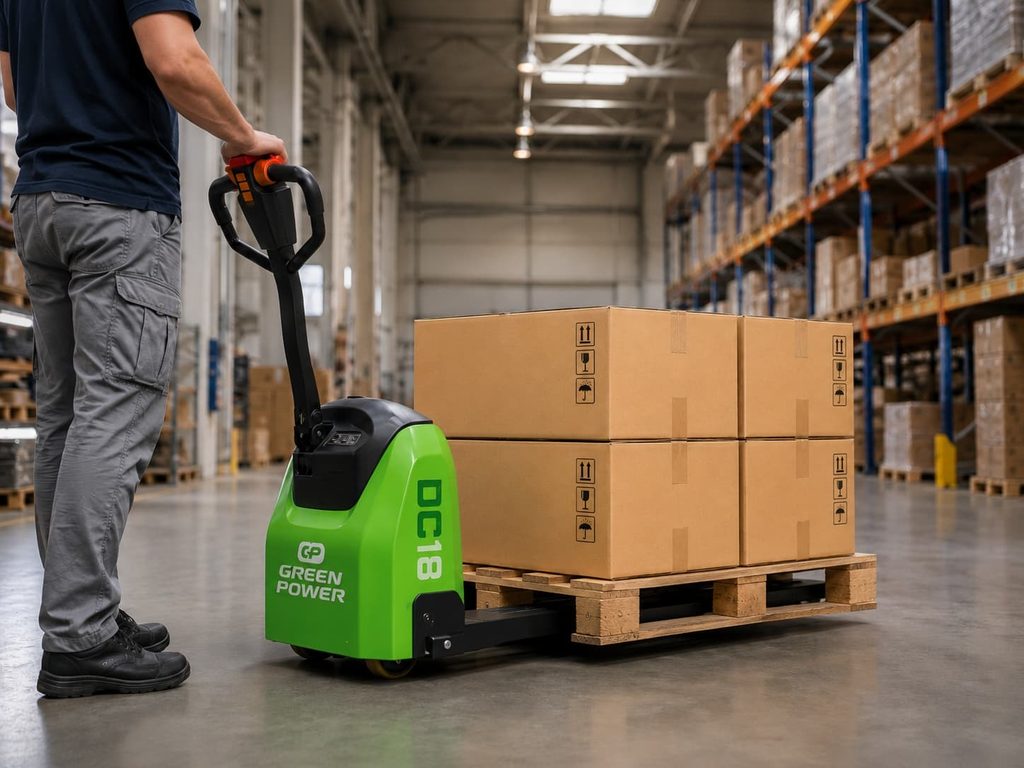
| 1,800kg | Standard warehouse use, compact operations | DC18 |
| 2,000kg | The industry standard for most warehouses | DC20 |
| 2,000kg | Heavy-duty stand-on, high throughput | ME20 |
| 2,500kg | Heavy-duty regular use | ME25 |
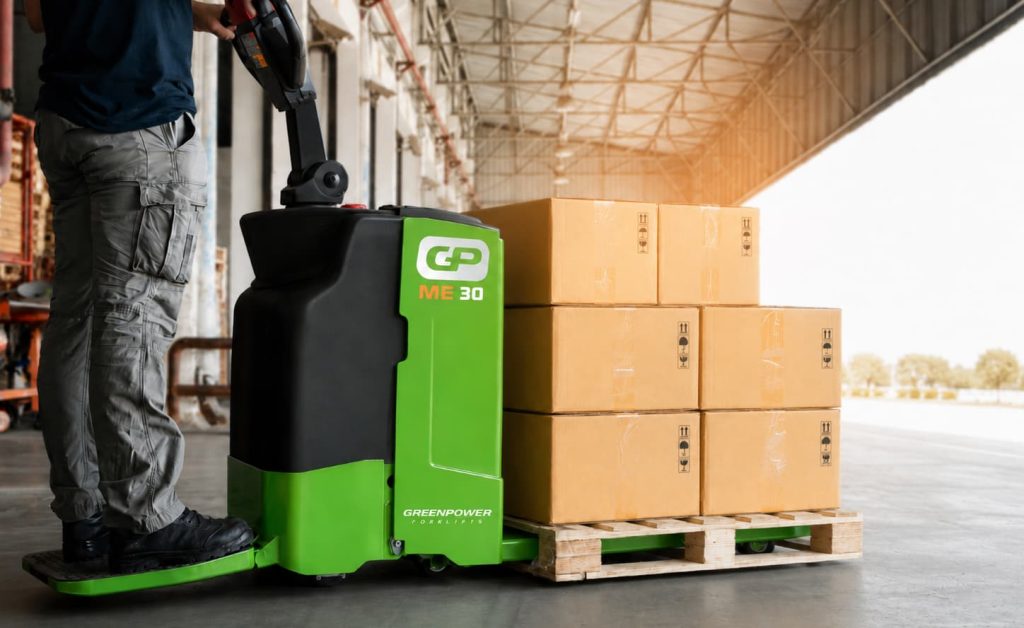
| 3,000kg | Demanding industrial and logistics | ME30 |
| 4,000kg | Heavy industrial applications | ME40 |
| 6,000kg | Extreme heavy-duty logistics | ME60 |
| 8,000-10,000kg | Maximum capacity platform trucks | ME80 / ME100 |
Never run a pallet truck at more than 80% of its rated capacity in regular operation. Always factor in the weight of the pallet itself, typically 22 to 25kg for a standard Euro pallet. Overloading is the leading cause of pallet truck failure and workplace accidents..
Walkie vs Stand-On Pallet Trucks: Which Do I Need?
Within the electric pallet truck category, there are two main operating styles. Choosing the right one depends on how far and how often your operators are moving loads.
Walkie (Pedestrian) Pallet Trucks
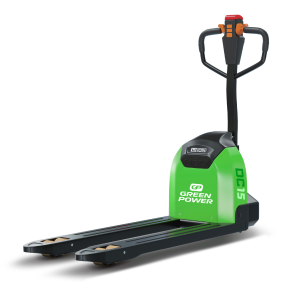
The operator walks behind or alongside the truck, controlling it via a handle. Greenpower’s DC15, DC18 and DC20 all fall into this category.
Best for:
- Short to medium distances, tight spaces, van loading, retail and light warehouse use
- Compact and easy to manoeuvre
- Lower purchase price
- Ideal for operations with occasional pallet movements
Stand-On (Rider) Pallet Trucks
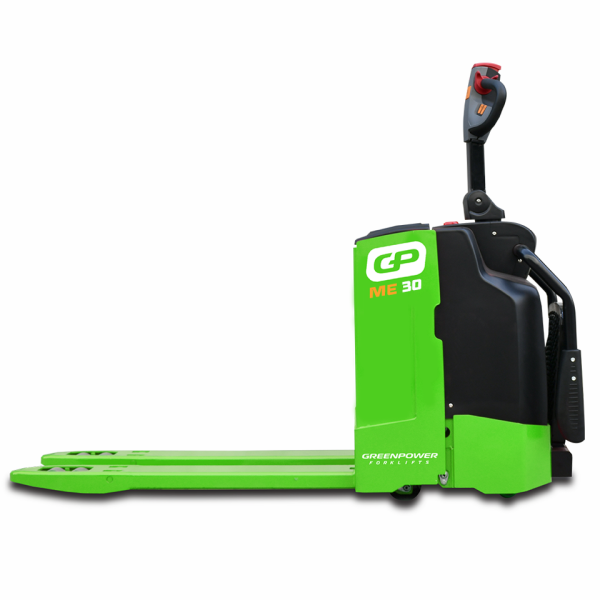
The operator rides on an integrated platform, significantly reducing fatigue and increasing speed over longer runs. Greenpower’s ME20 through ME100 are stand-on and platform models.
Best for:
- Longer travel distances, high-throughput warehouses, distribution centres and heavy-duty logistics
- Faster cycle times over distance
- Reduces operator fatigue across full shifts
- Available in much higher capacity ratings (up to 10,000kg)
The simple test: if your operators regularly travel more than 30 metres per pallet movement or move more than 20 pallets per hour, a stand-on truck will deliver better productivity and lower fatigue. For shorter runs and lighter throughput, a walkie model does the job well.
What Pallet Truck Dimensions Do I Need to Know?
Pallet truck dimensions determine whether your truck fits your pallets, aisles and doorways. Getting this wrong means a machine that literally cannot do the job.
Here are the three standard fork configurations used in the UK:
| Pallet Type | Fork Width | Fork Length | Common Use |
| Euro Pallet (800 x 1200mm) | 540mm | 1,150mm | EU imports/exports, UK logistics standard |
| Standard UK Pallet (1200 x 1000mm) | 680mm | 1,150mm | UK warehouse standard |
| Half Pallet / Small | 450mm | 800mm | Small businesses, lighter loads |
The most common configuration across the UK market is 540mm fork spread with 1,150mm fork length, compatible with Euro pallets, the most widely used pallet type in UK logistics. If your site does run on 1200 x 1000mm pallets, you will need the 680mm spread, so be sure to check what comes through your landing bay.
For tight-aisle environments, overall machine dimensions matter too. Always check your narrowest doorway, loading bay and aisle width before specifying. A truck that doesn’t fit is a truck that doesn’t work.
Why Should I Choose a Lithium Pallet Truck Over a Lead-Acid Model?
This is where modern operations pull ahead.
A lithium pallet truck uses lithium-ion battery technology instead of traditional lead-acid. The practical difference is significant:
- Faster charging: lithium-ion batteries charge fully in as little as 2 to 3 hours versus 6 to 8 hours for lead-acid
- Opportunity charging: top up during breaks without damaging battery life
- 2,000+ battery cycles: versus around 1,000 to 1,500 for lead-acid
- Zero battery maintenance: no acid, no watering, no venting, no dedicated charging room required
- Zero emissions: critical for indoor environments and sustainability targets
- Consistent performance: lithium-ion delivers full power from full charge to empty, while lead-acid gradually loses voltage as it drains
At Greenpower Forklifts, our full electric pallet truck range runs on lithium-ion from the entry-level DC15 (from £749 ex. VAT) through to the heavy-duty ME60 (£14,950 ex. VAT). Every model includes an integrated charger as standard.
How Much Do Electric Pallet Trucks Cost?
Electric pallet truck prices in the UK vary significantly based on capacity, type and specification. Here’s a clear breakdown of what you can expect to pay at Greenpower Forklifts in 2026:
Walkie (pedestrian) models:
| Model | Capacity | Price (Ex. VAT) *July 2026 |
| DC15 | 1,500kg | From £749 |
| DC18 | 1,800kg | From £899 |
| DC20 | 2,000kg | From £999 |
| EPL185 | 1,800kg | View pricing |
Stand-on and heavy-duty models:
| Model | Capacity | Price (Ex. VAT) *July 2026 |
| ME20 | 2,000kg | £4,950 |
| ME25 | 2,500kg | £4,950 |
| ME30 | 3,000kg | From £7,750 |
| ME40 | 4,000kg | From £8,950 |
| ME60 | 6,000kg | £14,950 |
| ME80 | 8,000kg | Contact us |
| ME100 | 10,000kg | Contact us |
All prices are ex. VAT. Flexible finance packages are available on every model to spread the cost across manageable monthly payments.
Do I Need Training or a Licence to Operate a Pallet Truck?
There is no formal licence required to operate a pallet truck in the UK. However, training is a legal obligation, and the standard expected depends on which type of truck you are using.
Walkie Pallet Trucks:
Under PUWER (Provision and Use of Work Equipment Regulations 1998), anyone using work equipment must be adequately trained. For powered pedestrian trucks such as the DC15, DC18 and DC20, that means training proportionate to the risk, covering safe operation, load handling, pedestrian awareness and emergency procedures.
Stand-On Pallet Trucks
Rider-operated trucks, including the ME20 through to the ME100, fall under HSE Approved Code of Practice L117, Rider-operated lift trucks: operator training and safe use. The expected standard is higher here: accredited basic training, followed by specific job training and familiarisation on the actual machine and site. Refresher training is recommended on a regular basis, typically every three to five years.
Either way, an untrained operator is a liability. Daily pre-use checks, including inspecting forks, wheels, brakes, controls and battery charge level, are non-negotiable. Any defects found must be reported immediately and the truck should not be used until they are rectified.
New vs Used Electric Pallet Trucks: Which Is the Better Investment?
Both new and used pallet trucks are valid options. The right choice depends on your operation and budget.
New electric pallet trucks offer full warranties, the latest lithium-ion battery technology and lower long-term maintenance costs. With prices starting from just £749 ex. VAT at Greenpower, a new pallet truck is more accessible than many businesses expect.
Used electric pallet trucks offer lower upfront costs. However, battery condition is the critical factor with any used electric machine. A used truck with a degraded lead-acid battery may need a replacement within months, wiping out any initial savings. Always check battery age, cycle count and remaining capacity before buying used.
If you’re running multiple shifts or moving heavy loads daily, buy new. The reduced downtime, full warranty coverage and longer service life make it the smarter financial decision. For very light-duty, occasional use, a used model can make sense if the battery is in good condition.
Do I Need a Pallet Truck or a Full Forklift?
This is a question we hear regularly, and the answer comes down to what you need to do with the load once you’ve moved it.
Choose a pallet truck if:
- You only need to move pallets horizontally at floor level
- You don’t need to stack pallets onto racking at height
- Your operation involves loading bays, retail stockrooms or vehicle loading
- Budget is a primary concern
Choose a forklift if:
- You need to lift pallets onto racking at height
- You handle heavy or mixed loads across larger sites
- You need to load and unload vehicles with raised trailer beds
- Your operation involves both indoor and outdoor work
If you need something in between, an electric pedestrian stacker bridges the gap. Stackers offer low-level lifting capability in a compact, walk-behind format without the cost or footprint of a full counterbalance forklift.
What to Check Before Buying an Electric Pallet Truck
- Load capacity: what is your maximum pallet weight? Don’t run at more than 80% of rated capacity
- Dimensions: do the fork width and length match your pallets?
- Walkie or stand-on: how far and how often are you moving loads?
- Lithium battery: it’s the only sensible choice for any regular-use operation in 2026
- Aisle width: will the machine actually fit your site?
- Charger type: does the truck charge via standard 3-pin plug or require a separate charger?
- New or used: weigh upfront cost against long-term running cost honestly
- Training obligations: factor in accredited training costs if your are specifying a rider-operated model
Ready to Find the Right Electric Pallet Truck for Your Operation?
At Greenpower Forklifts, we supply the UK’s leading range of lithium electric pallet trucks. From the compact DC15 at just £749 ex. VAT through to the heavy-duty ME100 handling up to 10,000kg, every model is backed by lithium-ion battery technology, competitive pricing, flexible finance and fast UK mainland delivery.
Contact Greenpower Forklifts today for one-to-one advice from our team. We’ll match you to the right truck for your operation.
FAQs
What is the difference between a walkie pallet truck and a stand-on pallet truck?
A walkie (pedestrian) pallet truck is controlled by an operator walking behind or alongside the machine. A stand-on pallet truck has an integrated platform the operator rides on, which reduces fatigue and increases speed over longer distances. Choose walkie for short runs and tight spaces, stand-on for higher throughput and longer travel.
How long does it take to charge an electric pallet truck?
Charging times depend on the battery type and size. Lithium-ion pallet trucks typically charge fully in 2 to 3 hours and support opportunity charging during breaks without damaging battery life. Lead-acid models take 6 to 8 hours plus a cooling period.
Can electric pallet trucks be used on delivery vehicles?
Yes. Compact walkie models like the Greenpower DC15 and DC20 are widely used for loading and unloading delivery vehicles. Their small footprint and lightweight design make them easy to carry on a lorry or van, and lithium batteries can be charged overnight via a standard plug.
What load capacity pallet truck do I need for a standard warehouse?
For most UK warehouse operations, a 2,000kg pallet truck covers the vast majority of standard pallet movements. This is the industry standard capacity. If you regularly handle heavier loads or industrial materials, step up to a 2,500kg or 3,000kg model.
How much does an electric pallet truck cost?
Electric pallet truck prices at Greenpower start from £749 ex. VAT for the entry-level DC15 walkie model. Stand-on heavy-duty models range from £4,950 to £14,950 depending on capacity. Flexible finance is available on all models.
Do electric pallet trucks require regular maintenance?
Electric pallet trucks require significantly less maintenance than combustion-powered equipment. Regular checks should cover fork condition, wheel and roller wear, brake function, electrical connections and battery health. Lithium-ion batteries are maintenance-free, with no watering or acid checks required.